Abstract
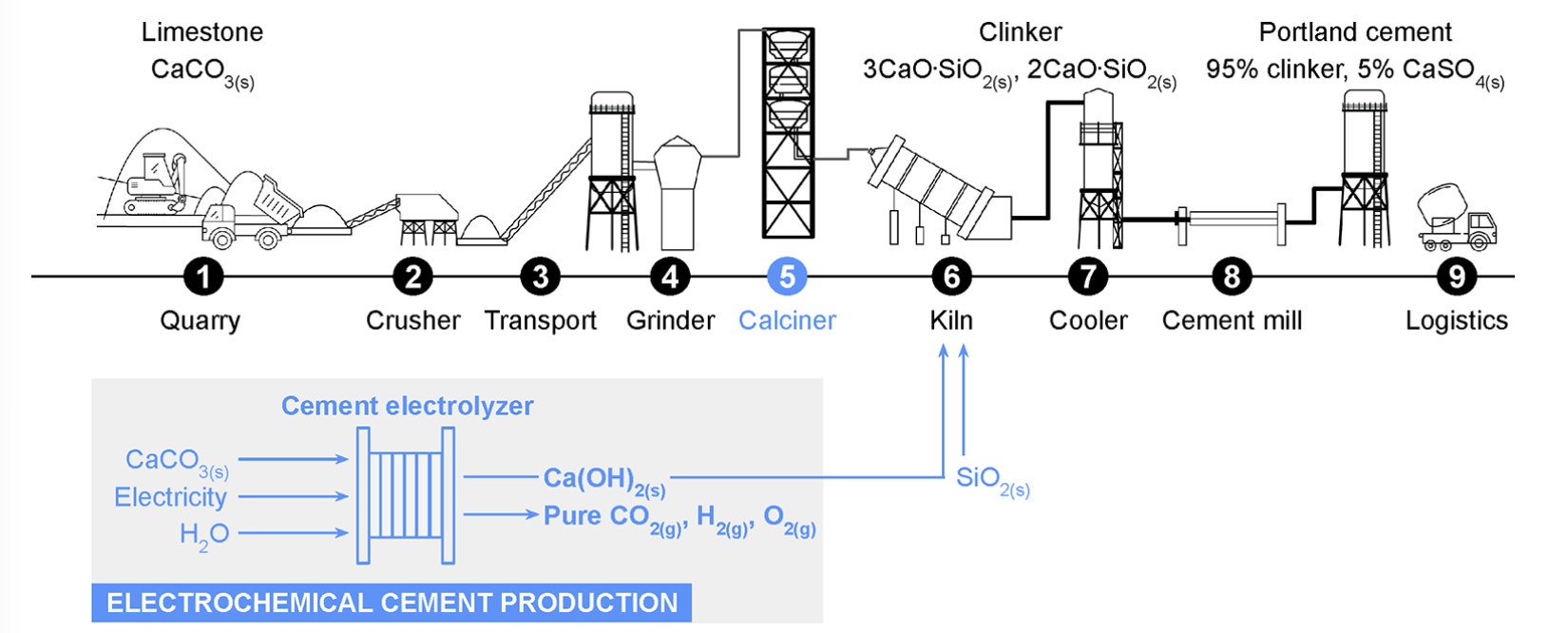
The carbon intensity of industrial cement production could be reduced by replacing the high-temperature kilns used to decompose limestone (CaCO3(s)). One possible solution is to use electrochemical reactors to convert CaCO3(s) into Ca(OH)2(s). The challenge is that most continuous-flow electrochemical reactors reported to date require voltages that are too high (>4 V at 100 mA cm–2) to be practical. A key reason for these high voltages is that the reactors contain a chemical chamber inserted between the anode and cathode chambers, which leads to a high Ohmic resistance. In this study, we present an electrolyzer that decomposes CaCO3(s) into reactive Ca2+ ions using only two chambers. This cell design, with an anode and cathode chamber separated by a membrane instead of a chemical chamber, follows a “zero-gap” configuration akin to hydrogen-producing electrolyzers and fuel cells. We also engage the reversible redox activity of (hydro)anthraquinones to mediate oxidation and reduction within a narrow electrochemical window. The streamlined “cement electrolyzer” is capable of operating at an initial full cell voltage of 0.38 V at 100 mA cm–2 with 100% proton efficiency.